
Thursday, June 30, 2022
Beginning of Hedging Duties
It seems very early to us but we are begining hedging duties starting with the fastest growing variety, the Cabernet Franc. Here is a photo of the Cabernet Franc getting a haircut.
 We want to hedge the vines as soon as they are beyond the reach of our spray nozzles because we learned from last year's lack of prompt attention that the young leaves of the growing vines are the first to get infected with mildews that get transmitted to the rest of the new shoots. The tradeoff here is that once the apical or growing end is cut off the shoots will transfer their growth to the summer laterals. We are already beginning to cut summer laterals that are as thick as the growing shoots in the Barbera.

Tuesday, June 28, 2022
Wine Making in a Warmer World
I was reading one of my wine news feeds which had this article: Climate change is altering the chemistry of wine. The article touched on the effect of fires on grapes as well as rising temperatures and the unpredictability of current weather patterns on winemaking and wine.
The Problem
For wine grape growing, a region’s climate change can disrupt the balance of sugar, acid and secondary compounds by changing the rate at which they develop over the growing season. A warmer growing season generates lots of sugars, fewer acids and undesirable changes in aromas.
 Warmer temperatures affect the rate at which sugar and acids are accumulated in a grape berry. The amount of sugar is important because that is what the yeast converts into alcohol. A berry which is higher in sugar content leads to a wine with a higher level of alcohol. In addition, the flavor of a very ripe berry is more like raisins leading to a boozy, raisiny, "cooked" tasting wine and the drop in acidity affects the longevity of the wine in the cellar.
The Solution
All of this has an impact on the wine and blurrs the sense of place, or "terroir" of a wine grown in a specific region.
References:
1. Ula Chrobak and Katarina Zimmer, Knowable Magazine, Climate change is altering the chemistry of wine, June 22, 2022.
2. Roger Voss and Kathleen Buckley, Beverage Industry Enthusiast, Bordeaux Aims to Protect its Future with New Grape Varieties
3. Wine Industry Network, Bordeaux Receives National Approval to Introduce Six New Red and White Grape Varieties in 2021, January 26, 2021.
The Problem
For wine grape growing, a region’s climate change can disrupt the balance of sugar, acid and secondary compounds by changing the rate at which they develop over the growing season. A warmer growing season generates lots of sugars, fewer acids and undesirable changes in aromas.

The Solution
All of this has an impact on the wine and blurrs the sense of place, or "terroir" of a wine grown in a specific region.
- In Bordeaux, for example, a traditional style for red wines is full-bodied with strong fruity aromas and a “pencil lead” earthiness. An earlier spring means that the grapes of traditional varieties mature during the peak of summer rather than in the fall, generating lots of sugars, fewer acids and undesirable changes in aromas.
In the past, Bordeaux was allowed to grow 6 red varieties (Cabernet Sauvignon, Merlot, Cabernet Franc, Petit Verdot, Malbec, and occasionally Carménère) and 8 white varieties (Sémillon, Sauvignon Blanc, Sauvignon Gris, Muscadelle, Colombard, Ugni Blanc, Merlot Blanc and Mauzac).
The unprecedented solution in Bordeaux as of 2021, is to allow the wine grape growers to grow an additional 4 red (Arinarnoa, Castets, Marselan and Touriga Nacional) and 2 white (Alvarinho and Liliorila) varieties. For the red Bordeaux, the addition of the French variety Arinarnoa can boost acidity and tannin levels and the Portuguese Touriga Nacional can ramp up powerful black fruit aromas that heat-sensitive varieties might lose. The caveat is that the final wine blend cannot contain more than 10% of these newly allowed grape varieties. - Another solution researched by plant physiologist, Gregory Gambetta at Bordeaux Sciences Agro and the Institute of Vine and Wine Science is to study how to climate-proof vines by using different rootstocks. Rootstocks control a plant’s overall vigor and water use and maybe selected to tolerate the warming world. UC Davis viticulture researcher Kaan Kurtural has been testing this hypothesis at the Oakville Experimental Vineyard in Napa Valley since 2016. Kurtural his colleagues have been monitoring 16 unique combinations of rootstocks and Cabernet Sauvignon clones to learn which combinations are most resilient under stressful conditions like heat waves and drought while still producing high-quality Cabernet Sauvignon grapes. So far, the Austrian rootstock Kober 5 BB, the French 3309 Couderc and 110 Richter have looked promising.
- Investigating the effects of different viticultural practices, including a carbon-sucking grass that can grow between rows and vines tied up to wires in numerous trellising styles
- The use of shade films to slow the ripening process to selectively filter the UV spectra to prevent the loss of heat sensitive flavor compounds
- Adapt winemaking techniques to produce a well rounded wine with riper grapes
References:
1. Ula Chrobak and Katarina Zimmer, Knowable Magazine, Climate change is altering the chemistry of wine, June 22, 2022.
2. Roger Voss and Kathleen Buckley, Beverage Industry Enthusiast, Bordeaux Aims to Protect its Future with New Grape Varieties
3. Wine Industry Network, Bordeaux Receives National Approval to Introduce Six New Red and White Grape Varieties in 2021, January 26, 2021.
Monday, June 27, 2022
Berry Set in the Vineyard
On June 24, I wrote a blog about Vintage 2022: June Update Annual Cycle of Growth. On that day, I also took pictures of all of our varieties and where they were with respect to berry set.
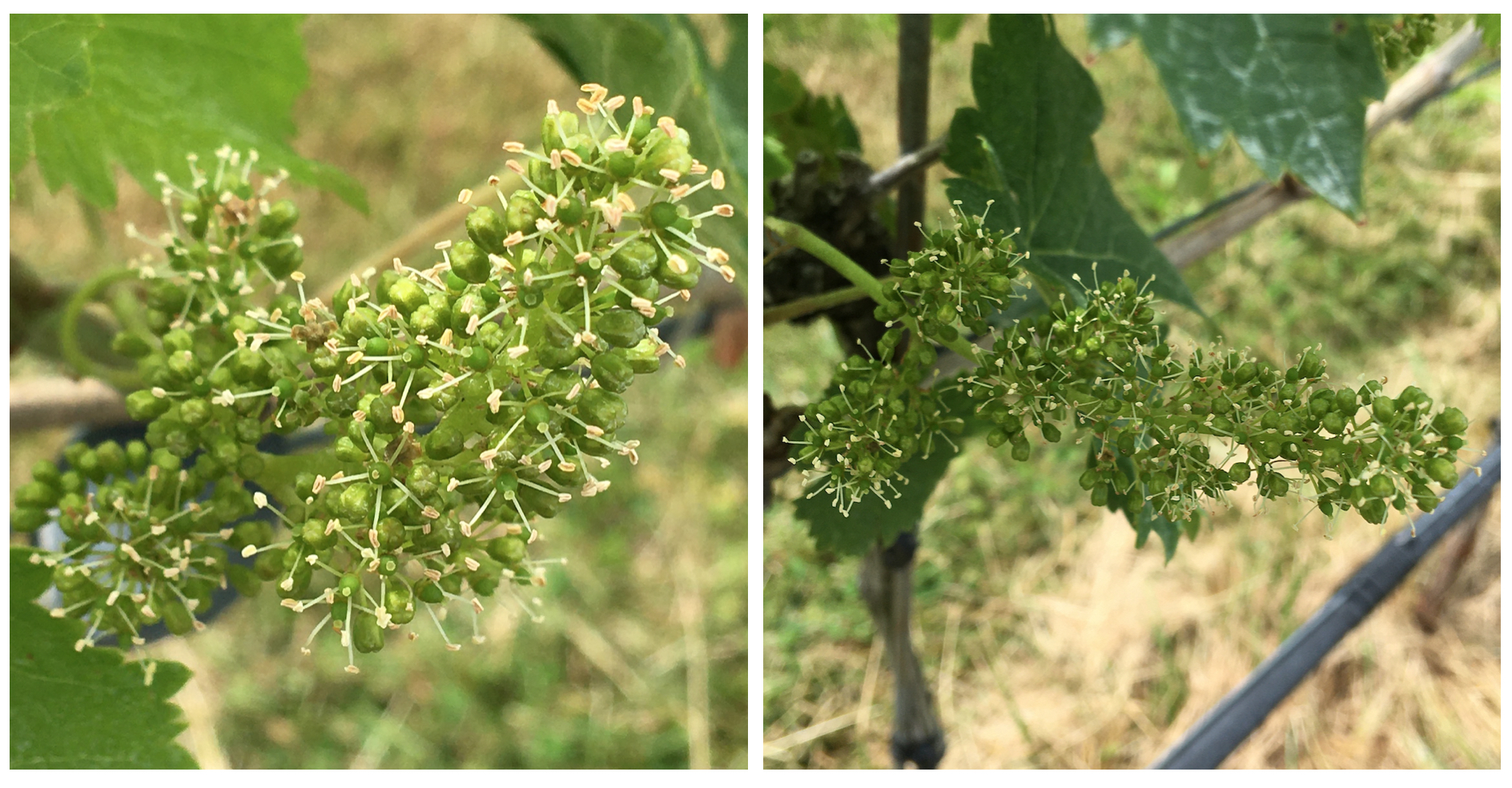
Here is a photo compilation of our vineyard at various stages of berry set: The photo shows that the Auxerrois, Chenin Blanc and Cabernet Sauvignon are still at flowering and the Chardonnay, Cabernet Franc and Barbera are at berry set.
Here is a summary of what happens during berry set from Ed Hellman's excellent article:1 The photo shows the initial stages of berry set, with the flower's filaments still attached to the developing berry. It also shows that one of the calyptra whithered while still covering the filaments. Cold temperatures, rainfall or high humidity are often associated with incomplete detachment of the calyptras leading to reduced fruitset.
References:
1. Ed Hellman, Grapevine Structure and Function.
Here is a photo compilation of our vineyard at various stages of berry set:

Here is a summary of what happens during berry set from Ed Hellman's excellent article:1
- Successful pollination and fertilization of the ovule leads to berry development
- Flowers with unfertilized ovules shrivel and die
- Many of the initially formed tiny berries abscise or drop off during the first 2-3 weeks
- Only about 20-30% of flowers on a cluster develop into mature berries; this is enough to develop a full cluster of fruit

References:
1. Ed Hellman, Grapevine Structure and Function.
Friday, June 24, 2022
Vintage 2022: June Update Annual Cycle of Growth
We have been busy weeding with our new Fischer Twister, shoot tucking and shoot positioning. On June 15th, we noticed that the Chardonnay had begun to bloom! I thought that was fast, but I checked on my annual cycle of growth chart and found out that we should have been anticipating bloom. Here is the chart for the last 2 years:
 The above dates for bloom for the various varieties are approximate. For example, my friend and I were shoot tucking and shoot positioning the Cabernet Sauvignon on Monday, June 20th and did not see any inflorescence in bloom, but the next day on June 21, when I went to check the Cabernet Sauvignon, it was about 40% flowering!
 Last year, we had rain events during flowering which we surmise lead to reduced fruit set and berry size. This year, I am keeping closer check on rain events during flowering. So far, this is what has occurred.
At the moment, it is difficult to discern if the rain has affected fruitset. I will keep on monitoring the various varieties to see what happens.

| Date | June 15 | June 17 | June 18 | June 19 | June 20 | June 21 | June 22 |
| Weather Conditions | Rain 4 am for 15 minutes | Steady rain in am | Steady rain in am to 1:30 pm | ||||
| Auxerrois | 20% | ||||||
| Chenin Blanc | 30% | ||||||
| Chardonnay | 20% | ||||||
| Cabernet Sauvignon | 40% | ||||||
| Cabernet Franc | 10% | ||||||
| Barbera | 30% |
Subscribe to:
Posts (Atom)