Thursday, June 30, 2016

Installation of the Pitless Adaptor

It was a dark and stormy night, but when we got up to the property, not a movement on the rain gauge. The vineyard was very moist, however, it seemed that no appreciable rain had fallen. It is not lost on us that it has been almost a month since we had our last rainfall which brought about 1-inch of rain. We do have a backup plan, which is our plan A.
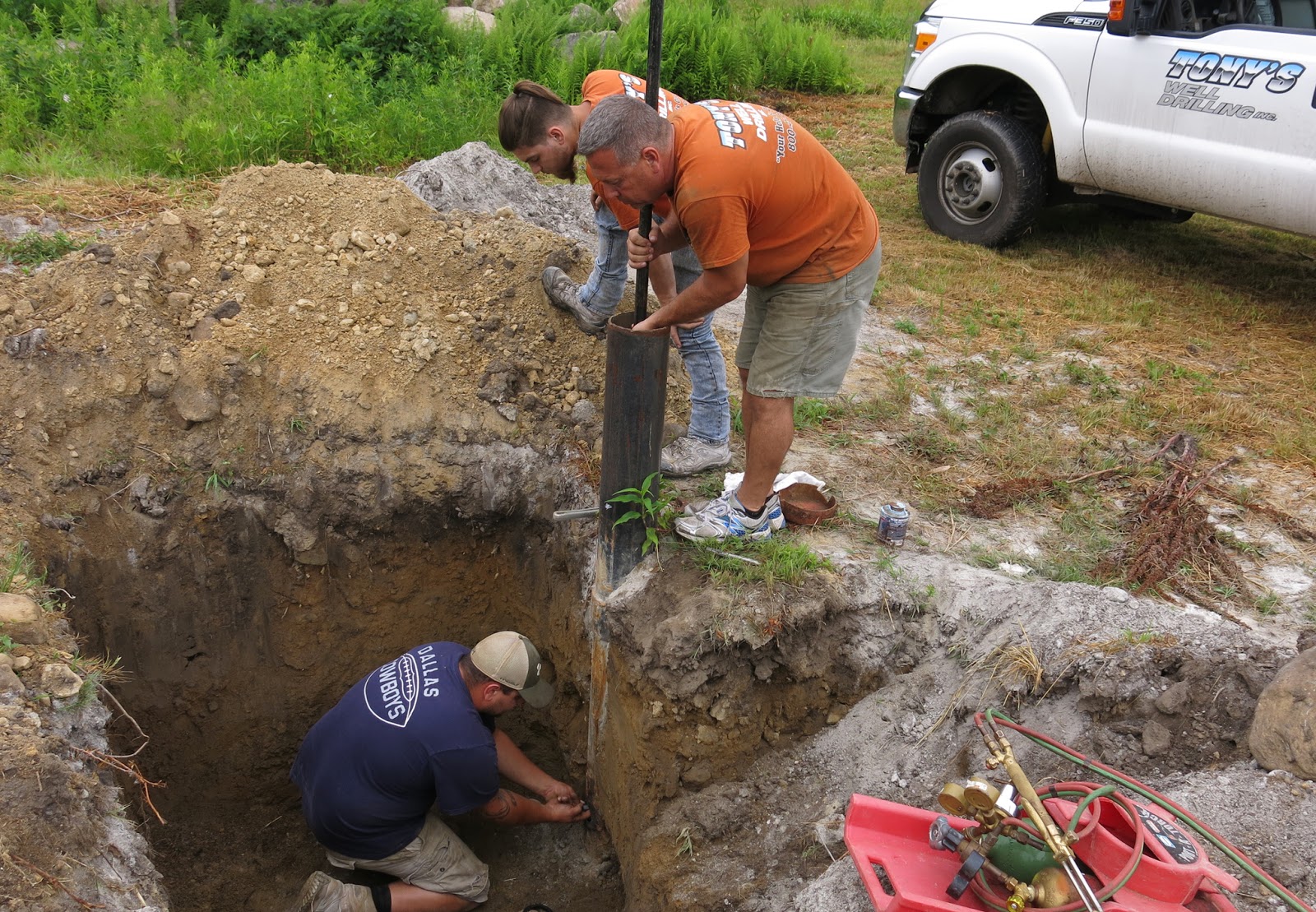
But, we have been waiting for the well crew to show up to put in the well pump. Today (really yesterday, June 29th), they came with the pitless adapter. I learned that there are many steps in making a well that has the potential to deliver 40 gallons a minute, functional. Today the crew installed the brass pitless adaptor. My husband kindly explained to me what a pitless adapter is. I find it to be very ingenious. But, first, you need to attach the pitless adapter to the sidewall of the existing iron pipe by cutting a hole with an acetylene torch. Then the parts that attach to the inside of the well pipe and the outside of the well pipe must be maneuvered in place. (Please see the annotated illustration provided above.)
What Tony is doing is using a pipe with a 90-degree fitting on which the "female" part of the pitless adapter has been placed and guiding it into the iron pipe and putting it into the hole that was cut. His co-worker is ready on the other side of the iron pipe to secure it with the gasket, back plate and the lock nut. One slip and down goes the part into the 600-foot well, but all's well that ends well. We now have a pitless adapter into which the drop pipe will be placed.

Monday, June 27, 2016

Flowering in the Vineyard

The first signs of flowering occurred in our Chardonnay and the photo on the right was taken on June 16. This is very similar to what happened last year on June 17th, when I blogged about The Sight of One Flower Blooming. It would appear that our Chardonnay is the first to bloom, followed by our Chenin blanc and then the Auxerrois.
Fast forward to Saturday, June 25, when we had our "thank you BBQ" for the people who came to help us plant our 4200 new vines. When we took our friends into the vineyard to see the results of their labor, we saw many tiny grapes the result of successful self pollination.
Indeed, conditions were ideal between June 17th and June 25th with no rain at all and moderate temperatures not exceeding 80 degrees Fahrenheit. While these conditions are ideal for fruit set, it is not so ideal for our newly planted vines. We have not had any significant rainfall since Monday, May 30th when we had a total of 1-inch of rainfall between early Sunday morning and Monday, Memorial Day. In one of our lessons learned (90% at the School of Hard Knocks), we know that newly planted vines need water, so while we wait (and wait) for our well pump installation to occur, we have been hand watering our new vines.

Thursday, June 23, 2016

The Secret Life of Ladybugs

We have been shoot positioning (among other tasks) in the vineyard, which takes us up close and personal with all of our vines. I have blogged about The Life Cycle of the Ladybug in a previous post in which I show this:
And now I can fill in one important step that takes place between the mature ladybug and the eggs. It is a very short video and the important part is in the first 1-3 seconds. Please be warned that to some, this is may be classified as an R-rated short clip.
This is good news for us because ladybugs are beneficial insects. Ladybugs are predators with ravenous appetites for aphids and other soft-bodied insects. Adult ladybugs will eat several hundred aphids before mating and laying eggs on the infested plants. Ladybug larvae feed on aphids as well.1
It is not clear from this video that these are truly ladybugs belonging to the family Coccinellidae or the invasive ladybug also belonging to the family Coccinellidae, but is in the genus Harmonia. The Harmonia axyridis also known as the Asian ladybug can be distinguished from the true ladybug because of the "M" marking that can been seen on its pronotum as shown in the beetle on the right.2 I learned a lot about the Asian ladybug on Frank Fielder's Wonderful World of Insects website.
One last word. A few weeks ago, we saw what I assumed was a ladybug and sent the photo to our ace identifier, Pamela Cooper from the University of Connecticut Extension Center and she thought it was a member of Harmonia axyridis. I can see where the pronotum might have an "M" but looks more like an "H" to me. I thought it had an amazing color and reminded me somewhat of an anchor bug which I wrote about in a previous post Anchor Bug: Natural Vineyard Pest Management Agent.
So much for a little light digression from the heaviness of understanding the development of inflorescence primordia, but that will be coming shortly!
References:
1. Debbie Hadley, Ladybugs - Family Coccinellidae.
2. Frank Fielder's Wonderful World of Insects.
3. National Geographic Lady Bug Coccinellidae

Tuesday, June 21, 2016

Grapevine Inflorescence Formation---Parts 1 and 2

Trying to talk about the formation of inflorescence is a little like the question, "Which came first, the shoot or the bud?" This topic is fraught with the unknown and the unknowable. A little illustration can help clarify this question and breaking up the cycle into 4 parts can also be helpful in the discussion.1
In this blog, I'm going to limit myself to what is going on in (1) and (2) of the cycle. If we begin at the top of this illustration (1) in spring of this year, bud break results in the growth of the shoot. Something that I learned recently when I read Markus Keller's book2 is that this shoot growth can be divided into two phases. The first is the fixed growth which results in the formation of the first 6 to 10 nodes and the second phase is the free growth which is the subsequent growth of the shoot. (This will become important later.)
As the shoot is growing, the dormant or winter bud is being formed directly above the leaf petiole and the shoot. The prompt or lateral bud can also grow in the leaf axil and result in the growth of the summer lateral shoot.3
(2) The dormant bud is formed in the spring from their own shoot apical meristem. In the following illustration, the shoot apical meristem is labeled A.2
The apical meristem of the primary bud generates two types of lateral meristems (labeled L in the illustration above): (1) is responsible for leaf production and (2) the other is responsible for inflorescence and tendril production.
Got all that? So, a lot is happening right now at the nodes of the growing shoots. More information to come in future blogs.
Reference:
1. For the illustration the grape inflorescence growth cycle was taken from:
Wine Science - Third Edition, Ronald Jackson
The grape bud was taken from:
YouTube: The Grapevine Bud
The was taken from:
Jennifer Hashim-Maguire, Managing the vegetative canopy and its effects on bud fruitfulness and fruit quality.
2. Markus Keller, The Science of Grapevines Anatomy and Physiology, 2010, Academic Press.
3. Charlotte Pratt, Vegetative anatomy in cultivated grapes, A review, American Journal of Enology and Viticulture, 1974, 25:131-150.
4. Devin Carroll, What Causes a Bud to Produce a Bunch or Not, Practical Winery and Vineyard, November/December 2009.
5. Markus Keller, Chapter 1
6. Larry Williams, Bud Development and Fruitfulness of Grapevines.