Pages
- Welcome
- Home
- Online Resources
- Starting a Vineyard
- Viticulture
- Enology
- Grape and Wine Chemistry
- Grapevine Diseases
- Insect Pests and Predators
- Vintage Notes
- Wine Tastings
- Wines Under $20
- Champagne
- Chenin Blanc
- Meetings and Workshops
- Book Reviews
- On the Wine Trail
- Esoterica
- Vineyard Sightings
- Winery Configuration
Sunday, July 19, 2020
Poor Fruitset in Chardonnay
We have been leaf pulling in the Chardonnay after fruitset was achieved and we are finding some sad conditions. This is what we are seeing in certain areas of the Chardonnay.
In other areas, the Chardonnay after leaf pulling in the fruit zone looks like this:
Sunday, July 12, 2020
Influence of sour rotten grapes on the chemical composition and quality of grape must and wine
In the last post, I wrote about What is Sour Rot, so now that we know all about sour rot, the real issue is, how can sour rot in wine affect it's flavors. The authors of the article, "Influence of sour rotten grapes on the chemical composition and quality of grape must and wine", sought to answer that question through their research.
They took healthy Trincadeira and Cabernet Sauvignon red grape varieties and added grapes affected by sour rot grown during the 2007 and 2008 harvest seasons on the vineyards of the Tapada da Ajuda at the Instituto Superior de Agronomia in Lisbon, Portugal. The grapes were picked clean and then sour rot infected Trincadeira grapes were added to the grapes in calibrated portions.
The grape must was measured for the following analytical parameters:
Two sensory analysis were conducted to determine whether there were sensory differences between sound grape–produced and sour rotten grape–produced wines. During the first sensory session held in 2007, was tasting panel was comprised of 3 women and 5 men during the second sensory session conducted in 2008, the panel was comprised of 5 women and 10 men.
The participants were not informed about the nature of the wine samples. In all cases, 30-mL wine samples were served at room temperature and presented to the panel in individual tasting booths, using transparent International Standards Organization (ISO) wine-tasting glasses, coded with three-digit random numbers. The sample order was randomized across all judges.
The wines were scored for the following sensory attributes:
The use of increasing grape sour rot percentages was associated with important changes in the initial chemical grape must composition, expressed by the increase in sugar content, total acidity, volatile acidity, color intensity, anthocyanins, total phenols, and by SO2 binding power.
The bottom line was that when the wines were tasted, after the MLF, rotten wines were not statistically different in terms of color, aroma, taste, and overall quality.
Still, I would not want to many any wine with sour rot.
References:
1. Andre ́ Barata, Alda Pais, Manuel Malfeito-Ferreira, Virgılio Loureiro, "Influence of sour rotten grapes on the chemical composition and quality of grape must and wine", Eur Food Res Technol, (2011), 233:183–194.
2. Illustration from Purdue University, Bruce Bordelon, Grapes: The Sour Rot Situation, August 25. 2016.
They took healthy Trincadeira and Cabernet Sauvignon red grape varieties and added grapes affected by sour rot grown during the 2007 and 2008 harvest seasons on the vineyards of the Tapada da Ajuda at the Instituto Superior de Agronomia in Lisbon, Portugal. The grapes were picked clean and then sour rot infected Trincadeira grapes were added to the grapes in calibrated portions.
The grape must was measured for the following analytical parameters:
- glucose–fructose content
- Brix degree
- density
- total acidity
- volatile acidity
- pH
- tartaric acid
- malic acid
- total assimilable nitrogen
- anthocyanins
- total phenols (Folin C index)
- color intensity
- (1) initial grape musts, before SO2 addition
- (2) after wine fermentation
- (3) after MLF
- (4) after 6 months of bottle aging (2008 wines)
- sour rot affected grapes resulted in pulp breakdown leading to berry dehydration and loss of berry juice
- large loss in free run must after crushing of grapes
- all sets with sour rotten grapes had higher quantity of stems, when compared with the respective control sets due to the necessity of adding more clusters to obtain the same amount of grapes in each vessel (30 kg/set)
- increase in the percentage of dry parts (skins, stems, and seeds) for the same grape volume leading to a higher concentration of extractable compounds
- after pomace pressing, a slight decrease in wine volume and a clear increase in lees volume were observed after MLF as a function of the proportion of sour rotten grapes
- sour rot contributed to a marked decrease in the final wine yield
- increased the Brix and glucose–fructose content and thus the potential alcohol content; observed increase in sugar was likely due to the process of concentration as a consequence of berry dehydration
- a rise in total acidity accompanied with an increase in volatile acidity and a drop in pH values; acetic acid bacteria (AAB) could also lead to a probable accumulation of other sugar degradation products such as lactic, propionic, and butyric acids, resulting in lower pH values
- increase in color intensity, anthocyanin, and phenol quantification, as a probable consequence of berry dehydration and higher skin and stems proportion relative to free juice
- considerable decrease in free SO2 content with the increase in sour rot
Two sensory analysis were conducted to determine whether there were sensory differences between sound grape–produced and sour rotten grape–produced wines. During the first sensory session held in 2007, was tasting panel was comprised of 3 women and 5 men during the second sensory session conducted in 2008, the panel was comprised of 5 women and 10 men.
The participants were not informed about the nature of the wine samples. In all cases, 30-mL wine samples were served at room temperature and presented to the panel in individual tasting booths, using transparent International Standards Organization (ISO) wine-tasting glasses, coded with three-digit random numbers. The sample order was randomized across all judges.
The wines were scored for the following sensory attributes:
- color (intensity); 5 point scale (1 = absent; 2 = weakly intense; 3 = intense; 4 = fairly intense; 5 = very intense)
- aroma (intensity, quality, and equilibrium); 5 point scale (1 = poor; 2 = satisfactory; 3 = good; 4 = very good and 5 = excellent)
- taste (intensity, quality, body, equilibrium, persistence, and final taste); 5 point scale (1 = poor; 2 = satisfactory; 3 = good; 4 = very good and 5 = excellent)
- overall quality; 20-point hedonic scale (1 = very bad; 5 = bad; 10 = acceptable; 15 = good; 20 = excellent)
The use of increasing grape sour rot percentages was associated with important changes in the initial chemical grape must composition, expressed by the increase in sugar content, total acidity, volatile acidity, color intensity, anthocyanins, total phenols, and by SO2 binding power.
The bottom line was that when the wines were tasted, after the MLF, rotten wines were not statistically different in terms of color, aroma, taste, and overall quality.
Still, I would not want to many any wine with sour rot.
References:
1. Andre ́ Barata, Alda Pais, Manuel Malfeito-Ferreira, Virgılio Loureiro, "Influence of sour rotten grapes on the chemical composition and quality of grape must and wine", Eur Food Res Technol, (2011), 233:183–194.
2. Illustration from Purdue University, Bruce Bordelon, Grapes: The Sour Rot Situation, August 25. 2016.
Monday, July 6, 2020
What is Sour Rot
I came across this paper"Influence of sour rotten grapes on the chemical composition and quality of grape must and wine" which was of interest to me because we have had sour rot problems in our vineyard, most noticeably in 2018 when we chose to leave our grapes hanging so that we could increase the sugar content but in the meantime due to the rains that came, we lost a significant portion of our crop to sour rot.
So, what is sour rot?
Sour rot occurs due to the action of a complex group of organisms involved in changing fruit composition as a result of the production of high levels of a wide range of undesirable metabolites including acetic acid, glycerol, ethyl acetate, ethanol, acetaldehyde, galacturonic acid, and gluconic acid.
Sour rot is troublesome with tightly packed, thin-skinned cultivars, and dense bunches close to harvesting, even when produced with low canopy densities.
Sour rot may cause heavy crop losses and reduce vintage quality, mainly when heavy rainfalls during fruit maturation and often determines harvest date in warm and humid regions. Sour rot, is becoming more frequent, probably due either to better gray rot, Botrytis cinerea prevention or to climate changes that favor the growth of other microorganisms.
Especially nearing harvest time, sour rot shows distinct and clearly recognizable symptoms:
References:
1. Andre ́ Barata, Alda Pais, Manuel Malfeito-Ferreira, Virgılio Loureiro, "Influence of sour rotten grapes on the chemical composition and quality of grape must and wine", Eur Food Res Technol, (2011), 233:183–194.
2. Illustration from Purdue University, Bruce Bordelon, Grapes: The Sour Rot Situation, August 25. 2016.
So, what is sour rot?
Sour rot occurs due to the action of a complex group of organisms involved in changing fruit composition as a result of the production of high levels of a wide range of undesirable metabolites including acetic acid, glycerol, ethyl acetate, ethanol, acetaldehyde, galacturonic acid, and gluconic acid.
Sour rot is troublesome with tightly packed, thin-skinned cultivars, and dense bunches close to harvesting, even when produced with low canopy densities.
Sour rot may cause heavy crop losses and reduce vintage quality, mainly when heavy rainfalls during fruit maturation and often determines harvest date in warm and humid regions. Sour rot, is becoming more frequent, probably due either to better gray rot, Botrytis cinerea prevention or to climate changes that favor the growth of other microorganisms.
Especially nearing harvest time, sour rot shows distinct and clearly recognizable symptoms:
- grape pulp browning
- disaggregation of the internal tissues and detachment of the rotten berry from the pedicel
- juice leaking from higher to lower berries in the cluster
- release of a pungent odor of acetic acid (vinegar) and ethyl acetate from the rotten berries
- the presence of Drosophila fruit flies, all around and on rotten bunches
- in the final stages, the berries are completely empty and the skins are dried out as a result of the complete fermentative breakdown of the pulp
- (a) biotic and abiotic agents that damage the skin, produce microscopic epidermal fissures, or stimulate berry splitting (insects, birds, diseases such as mildews and rots, pests such as grape moths, excessive swelling of the berries and the pressure of surrounding grapes, and mechanical and physiological injuries)
- (b) fruit flies (Drosophila spp.), quickly attracted by the injured grapes, carrying yeasts and acetic acid bacteria that enhance the process and speed up its spread throughout the entire cluster
- (c) climate conditions, mainly high temperature, that promote the growth of microorganisms responsible for the sour rot
- (d) opportunistic microorganisms (mainly yeasts, acetic acid bacteria, and other fungi) that colonize the injured skins and inner tissues of grape berry
References:
1. Andre ́ Barata, Alda Pais, Manuel Malfeito-Ferreira, Virgılio Loureiro, "Influence of sour rotten grapes on the chemical composition and quality of grape must and wine", Eur Food Res Technol, (2011), 233:183–194.
2. Illustration from Purdue University, Bruce Bordelon, Grapes: The Sour Rot Situation, August 25. 2016.
Thursday, July 2, 2020
Vintage 2020: July Brings Needed Rain
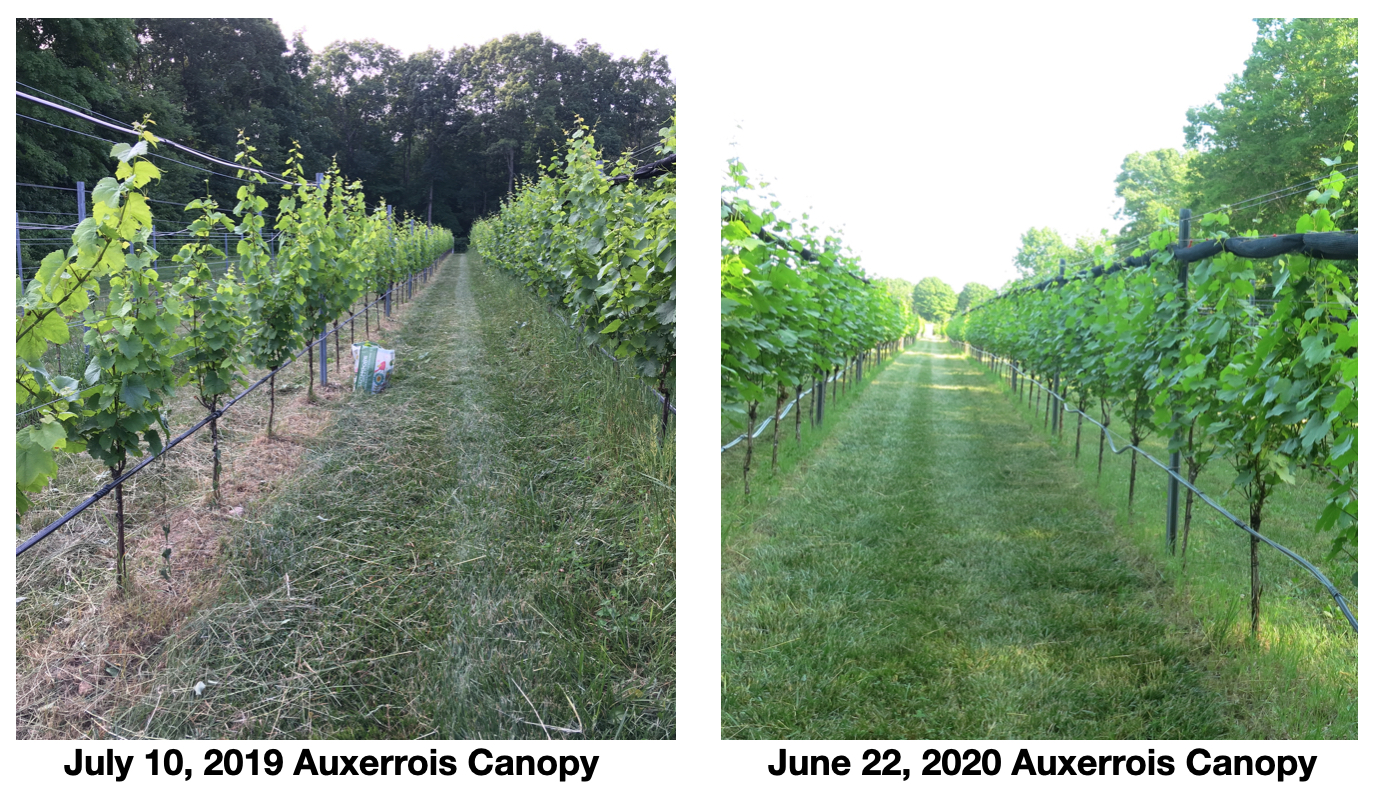
Connecticut has been in a draught situation since we have not had any rain since June 11, 2020 when we did have a soaking rain. I was doing a bit of complaining about all the rain we had in May and in the first half of June. Although, to be honest that rain was very good for our vines during the period between budbreak and growth. We have not seen such fast growth of our vines ever!
Here is a comparison of our Auxerrois growth during July 2019 and June 2020. Although the perspective is not quite the same, the 2019 shot is from south looking north and the 2020 view is from north looking south, it is clear that the canopy in 2019 is much less advanced than in 2020.
Here is a comparison with the same view in the Auxerrois this year:
The draught situation finally ended on June 27th when there was a light rain that came in the early evening. However, a much more serious rain came on the first day of July. We knew the rains were coming in the afternoon, but we had things to do in the vineyard. This is the shot we got as we left the vineyard yesterday.
Subscribe to:
Posts (Atom)


