My husband purchased this 2014 Bedell Cabernet Franc from our local package store. Bedell Cellars is located on Long Island founded by Kip and Susan Bedell in 1980. Since Long Island is just across the Long Island Sound from us and since we are now trying our hand at growing Cabernet Franc, we were interested in tasting the Long Island expression of Cabernet Franc. Cabernet Franc is used as a blending grape in Bordeaux, but it can be very interesting as a wine on its own merit. We always refer back to the stainless steel fermented Cabernet Franc that we tasted in Ontario many years ago that was so perfumey and sublime, we thought it was Pinot Noir.
This 2014 Bedell Cabernet Franc does not disappoint. It has a medium body with a healthy extraction of color, a nice hint of fruit, tannins that have been tamed and some acids that work well with a meal of wild meat with a topping of cheese.
Pages
- Welcome
- Home
- Online Resources
- Starting a Vineyard
- Viticulture
- Enology
- Grape and Wine Chemistry
- Grapevine Diseases
- Insect Pests and Predators
- Vintage Notes
- Wine Tastings
- Wines Under $20
- Champagne
- Chenin Blanc
- Meetings and Workshops
- Book Reviews
- On the Wine Trail
- Esoterica
- Vineyard Sightings
- Winery Configuration
Thursday, October 13, 2016
Tuesday, October 11, 2016
Fermentation?
We have 3 one-quarter stainless steel kegs in our fermentation chamber that currently holds our Chenin blanc harvest. We harvested our first one-quarter keg on September 17th, allowed it to cold settle the gross soluble solids and kicked off our fermentation on September 25th. We observed the slow start of fermentation 44 hours later. But, like any anxious parent we were holding our breaths until we could see this event.
For our second harvest that occurred on September 26, we followed our typical protocol of settling the gross soluble solids and added our yeast on October 2nd. We waited at least 48 hours to see if we could observe any signs of fermentation on those two kegs and nothing was happening. I looked online to see if I could learn anything about why fermentations can fail and I found an excellent enumeration a la David Letterman called Top 10 Reasons For Fermentation Failure at the E.C. Home Winemaking & Beer Making Supplies Website.
- Fermentation temperature too hot or too cold
- Adding too much sugar at the beginning of fermentation
- Improper yeast starting method
- Sealing up the fermenter after adding sulfites
- Using a wine airlock at the beginning of fermentation
- Lack of nutrients
- Fermentation has already completed
- Yeast has reached its limit
- Using distilled water
- Yeast is too old
- Defective fermentation locks
Monday, October 3, 2016
2010 Travaglini Gattinara
This wine is in a bottle that has a very weird shape, so that might be the first thing that catches your eye. But, don't stop there, pick up the bottle, take a risk and buy it.
Gattinara is a wine district (D.O.C.G.) in the northern Piedmont in Italy. This is the area that produces wine from the Nebbiolo grape. I found much more information online at the Travaglini Gattinara Site. In 1920, Clemente Travaglini established the winery that bears his name. Since that time, the winery has been in the family and the fourth generation of Travaglinis, Cinzia Travaglini and her husband Massimo Collauto are the current stewards.
The wine is made in the following way:
Winemaking: crushed and macerated for about 15 days in stain-less steel tanks at controlled temperature. The wine is aged for 3 years, 2 years in Slovenian oak of different origin and size, then rest in the bottle for 3 months.
With 6 years of age, the wine had very soft tannins. The deep color of the wine and the berry notes that create it's bouquet and flavor, makes it a perfect paring for a hearty beef stew.
But, back to the bottle shape, I've extracted this information from their website:
An exceptional wine deserves an exceptional bottle. It was with that in mind that in 1958, Giancarlo Travaglini set out to create a bottle that was also a work of art. This special bottle, exclusive to Travaglini, was designed to grace the most prestigious tables in the world. The shape of this bottle naturally catches sediment during pouring, allowing the wine to be served directly from bottle to the glass without decanting.
We paid around $30.00 for this wine, so while it doesn't qualify for my Wines Under $20 Tab, it is an excellent value for a Nebbiolo.
Gattinara is a wine district (D.O.C.G.) in the northern Piedmont in Italy. This is the area that produces wine from the Nebbiolo grape. I found much more information online at the Travaglini Gattinara Site. In 1920, Clemente Travaglini established the winery that bears his name. Since that time, the winery has been in the family and the fourth generation of Travaglinis, Cinzia Travaglini and her husband Massimo Collauto are the current stewards.
The wine is made in the following way:
Winemaking: crushed and macerated for about 15 days in stain-less steel tanks at controlled temperature. The wine is aged for 3 years, 2 years in Slovenian oak of different origin and size, then rest in the bottle for 3 months.
With 6 years of age, the wine had very soft tannins. The deep color of the wine and the berry notes that create it's bouquet and flavor, makes it a perfect paring for a hearty beef stew.
But, back to the bottle shape, I've extracted this information from their website:
An exceptional wine deserves an exceptional bottle. It was with that in mind that in 1958, Giancarlo Travaglini set out to create a bottle that was also a work of art. This special bottle, exclusive to Travaglini, was designed to grace the most prestigious tables in the world. The shape of this bottle naturally catches sediment during pouring, allowing the wine to be served directly from bottle to the glass without decanting.
We paid around $30.00 for this wine, so while it doesn't qualify for my Wines Under $20 Tab, it is an excellent value for a Nebbiolo.
Saturday, October 1, 2016
More From Harvest 2016
We are so thankful that our friends were able to join us on Monday for the harvest of our Chenin blanc. It turned out that we had 1/2 inches of rain on Monday night into Tuesday and then more rain on Wednesday and Friday. So Monday, it turns out was our little window of opportunity.
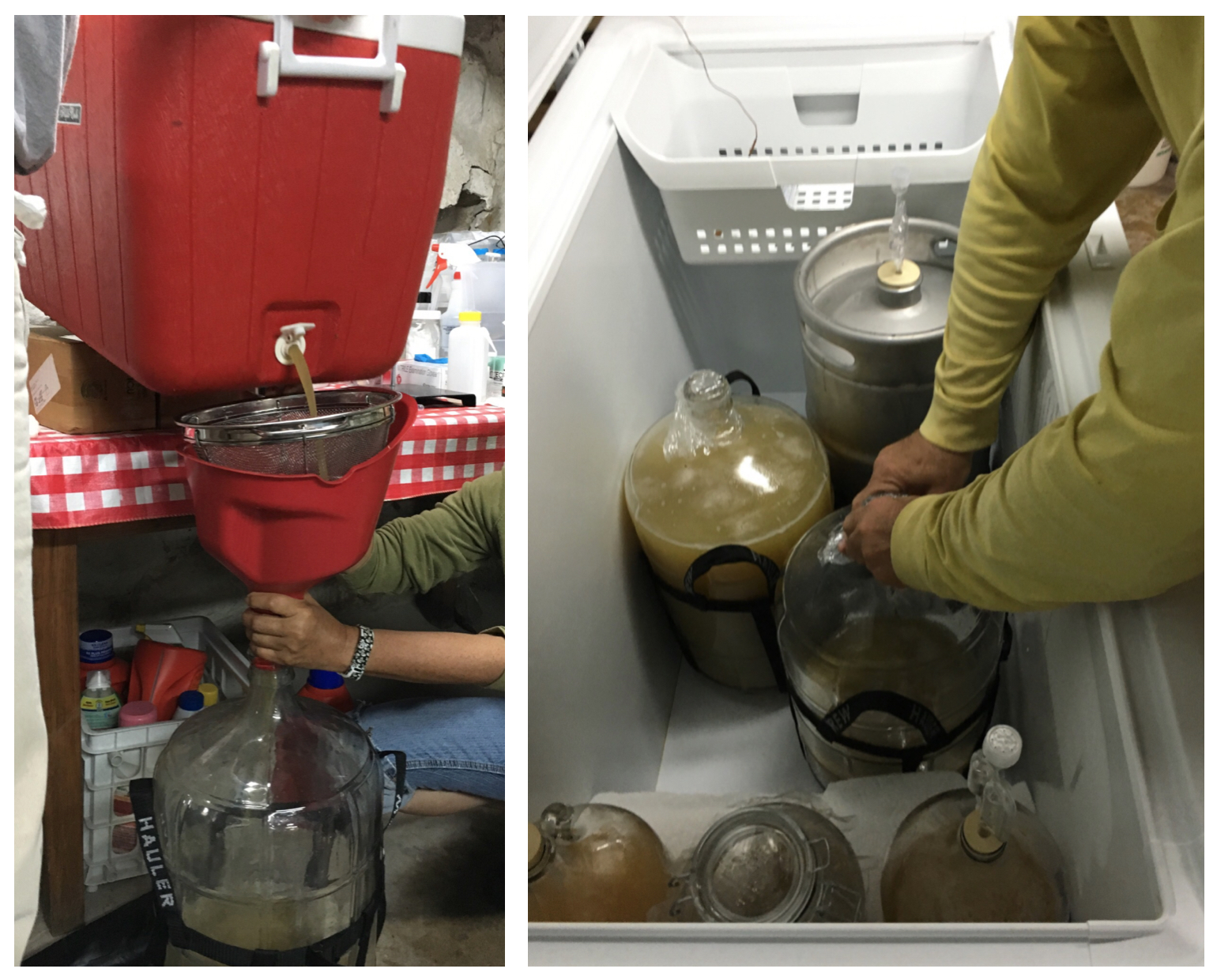
Here are pictures of some photogenic grape clusters from the harvest: After stomping on the grapes in the Igloo cooler, the spigot on the cooler makes it the ideal container for gravity assisted transfer. After the glass carboy was filled, it went into the fermentation chamber for cold settling of the gross soluble solids. The fermentation chamber is getting a little full this year.
Subscribe to:
Posts (Atom)