Saturday, September 12, 2015

Harvesting our Auxerrois

On Wednesday, in advance of a storm that was heading our way, we harvested our Auxerrois. There were only 14 clusters so the job was an easy one. Here is how it looked in our cooler.
I weighed the bunches and found that the 14 clusters weighed 2.57 pounds.
I covered the bowl with Saran wrap and put it in our basement refrigerator, while I contemplate what I can do with 14 bunches of grapes. My husband took one of the bunches to our local package (aka wine and beer) store and had the owner taste the grapes. He was surprised that the grapes were so small but was so much sweeter than table grapes.

Wednesday, September 9, 2015

Testing the Chenin Blanc Grape Juice

The two bunches of Chenin Blanc grapes that I harvested for taking the Vital Statistics sat in the refrigerator for a few days. Then, I had an idea to take one more reading. First, I assembled the following: a ziplock bag into which I put the two clusters, a clean glass, and some pH strips that I had around for testing the pH of canned salsa.
First, I squashed as much of the juice out of the two bunches that I could and then I put the juice into the glass. I took the pH strip and dipped it into the juice and got the result that you see to the right.
The color is somewhere in between the first indicator, which is 2.8 and the second indicator which is 3.2. This is really not very precise at all but something that I could do. This juice has some acidity!
I then put the cup of juice into the refrigerator to simulate cold settling that we would do to settle out the grape solids. The juice turned a little brown in the refrigerator, indicating the conversion of caftaric acid, one of the most abundant phenolic compounds in white grapes, into the quinone form by the enzyme polyphenol oxidase (PPO).
Polyphenol oxidase is the same enzyme that turns a freshly cut apple brown. This reaction occurs in the presence of oxygen and can be beneficial in the process of making a white wine, although the presence of too much oxygen can lead to a process known as Hyperoxidation, and that process is not necessarily something that is desired in winemaking.
A close inspection of the photo on the right where the juice has turned brown, shows that the gross lees have indeed settled out. My husband and I tasted the juice and it was sweet with a punch of acidity. Our thoughts are turning to how to make wine from the 320 netted clusters in the vineyard. Stay tuned.

Friday, September 4, 2015

Chenin Blanc Vital Statistics

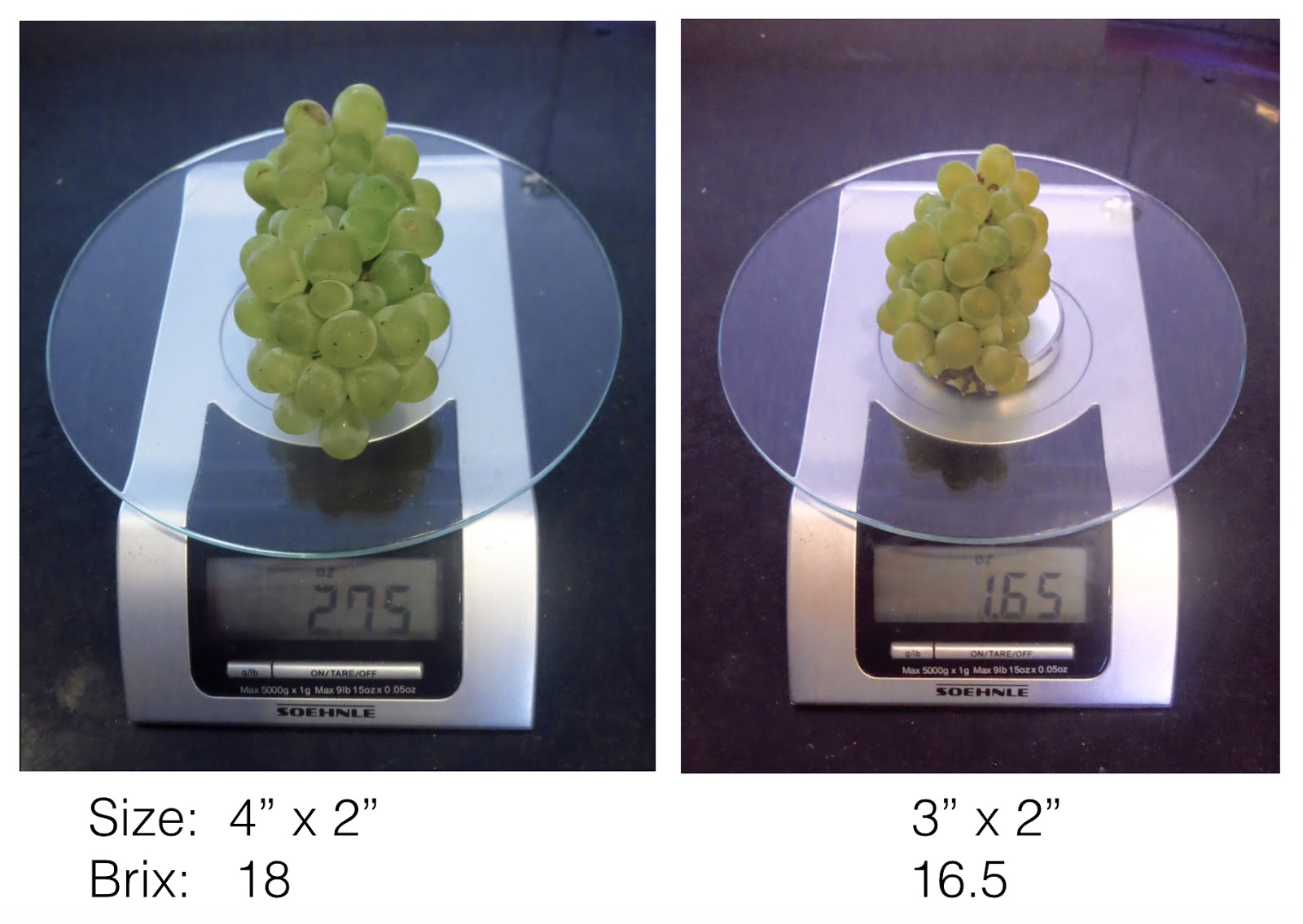
On Tuesday of this week when we had our Plans Interrupted by the arrival of a voracious flock of turkeys that discovered our sweet grapes, I took the opportunity to pick 2 clusters of Chenin Blanc that we didn't have the time to net so that I could check it's vital statistics. These are like our babies, so they were weighed and measured and checked for Brix level:
Yesterday, when we went to the vineyard to work, it appeared that the grapes were increasing in length as well as swelling. The oBrix were now averaging 19!
We also learned that harvest will soon begin for our neighbors to the south on Long Island!

Tuesday, September 1, 2015

Plans Interrupted

Yesterday, we arrived at the land, as we usually do, with plans for the day. The plan for the day included my husband testing the grape hoe to clear the weeds but as we turned toward the vineyard, my husband said, "Look at the turkeys!" I said, "Where?" and began fumbling for my camera. The turkeys were at the south end of the vineyard with their heads pointed in the direction of our grapes and what big, fat turkeys they were!
We both jumped out of our truck and my husband was flapping his arms and running in the direction of the turkey flock. They did not really go scattering, but went sauntering down the vineyard row as if to get yet another nibble of grape goodness before leaving.
After driving the turkeys out of the vineyard, we both surveyed the damage. The turkeys had just begun their breakfast of grapes from the south end of our vineyard and were on their meticulous and leisurely eatfest down the row. The grapes are at the perfect height for nibbling and they did a good job of pecking and eating each individual grape. The damage had just begun and if we had arrived any later, we would probably have seen a total annihilation of our little crop and not really known what caused the damage.
So, an abrupt change of plan was in order. It is not like we were unaware of bird problems, because we have been putting up netting on our Auxerrois that is already at 16 oBrix and getting sweeter. We were more focussed on smaller bird problems, such as starling getting to our grapes and didn't think that the flock of turkeys would partake of grapes. Wrong.
So, we devised a way of using our trailer to unroll the netting that we purchased and went down each row to net the surviving grapes.
So, another lesson learned the hard way....turkeys love grapes.