My wife and I, along with a couple friends, ventured into Washington’s Yakima Valley to explore a few wineries over a recent holidy weekend. Spring and Fall are great times to visit while it is not too hot and one can get away from the rain on the west side of the Cascades (Seattle). On our journey we hit a couple wineries down in Prosser and a couple on the way back in Zillah. Most of the wineries fit the prototypical experience here in Washington: excellent views, airy and impressive tasting rooms, along with varying levels of intimate tasting experiences.
We had a wonderful time in particular at Ruby Magdalena Vineyards in Zillah.
A connection through my parents (UC Davis Enology and Viticulture) led us to Ruby Magdalena Vineyard to meet up with winemakers Marty and Ryan Johnson, and a fantastic time. We were able to sit down and have a wonderful tasting experience along with a nice education about various wine topics.

Ruby Magdalena is located in the Rattlesnake Hills where grapes grow alongside cherries, apples, and pears. As our group pulled up to Marty’s vineyard, Marty and his 3 very enthusiastic dogs greeted us. One is a German Shepard, and the other two had mixes of Timber wolf in them! They are happy dogs that are just as tall as myself, which mean they are about 6’4” in height! We went to Marty’s shed where the project of the day was fixing a lawnmower blade, and we noticed he was also drying some grapes to do an Italian Passito. From there we toured around his 1.5 acres of planted grapes, which were running a little thirsty for water. Much like California, the snowpack in the Cascade Mountains was rather light this year, and most of the Yakima area shut off irrigated water for a couple weeks, until June 1, when it was deemed okay to use some of the water reserves the county had stored up.
Marty was born and raised in the hills of Northern New Mexico. His family line is actually Spanish from the days when the Spaniards came to Mexico and inhabited the various regions of Old Mexico. This has inspired his passion to grow Spanish grapes, which serves as something unique here in Washington. Spanish wines are generally less popular overall in the United States. I first discovered the breadth and depth of wines at Spanish chef José André’s Jaleo restaurant in Washington DC. Take a look at his wine menu or any other well-known Spanish chefs and you will see. Marty grows Tempranillo, Garnacha Tinta, and Graciano grapes. Right now Marty has Tempranillo and Garnacha Tinta in production, with plans for a Graciano in a couple years.

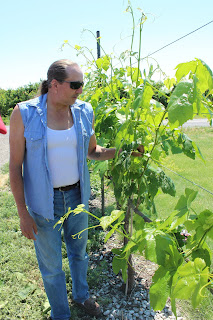
Marty pointed us to some little grapes and flowers starting on his vines. Having not really seen them at this point in the process before, it was a particularly educational glimpse into the entire life cycle in the making of wine. We then went over to some table grapes he has planted in his front yard, which he likes to employ for educational purposes. He showed us the flowers on them, and explained why they don’t really need elegant flowers for cross-pollination; they can do it on their own! After discussing the flowering and fruit process for grapes we sat on Marty’s back porch, to share a glass and some snacks we had brought along.
On his porch, we sat down on a large picnic table that has sweeping views of the Rattlesnake hills, along with the prominent vistas of Mt. Rainier and Mt. Adams. Even on a cloudy Northwest day, the large mountains were still a beautiful backdrop. I could visualize the amazing sunsets that Marty and Ryan often witness, as the Yakima area gets 300 days of sun. Along the property’s edge there are also some trees that makes the sunset very “Tuscan-like” as Marty described.


While we enjoyed the view we noticed a few forms of pest management that Marty and his wife employ. First of all, they keep about a dozen cats on their property to handle the pests on the ground. From what we could see, those cats worked hard and played hard. Next, we noticed the nets that were at the bottom of the vines, which would be wrapped around the plants when the grapes start to come in to keep birds from pecking at them. Two methods that his neighbors used included shiny tinsel in the trees and a “bird cannon” which sounds a loud boom sporadically every few minutes. Marty explained that unlike the nets, the birds get used to the other methods, as they are simply temporary distractions. The nets, he assured us, are the best way to assure that birds won’t get to the grapes.
Marty works for a larger winery in the area, where he painstakingly presses 40 gallons of grapes at a time to produce about 2,000 cases. In his spare time, he is tending to his own grapes and processing them in the same manner as well. I would call myself and our group novice wine drinkers (especially with regards to Spanish wines). Nevertheless, we can taste what is good and bad, but pinpointing notes is difficult.

Marty’s wines are terrific, and made with a passion for the process. The Grenache Rose is not for the faint of heart. The sugars are little more concentrated than a typical Rose I have had, which leads to a higher alcohol content. The wine has a nice, well-balanced sweet flavor to it. I imagine it goes great with those sunsets after dinner. Marty also served a little bit of Gamay that he has been at work on over at his job. It was really coming along nicely. We enjoyed the Tempranillo as well. I’ll leave it up to Hanumangirl & Co. to write about the Ruby Magdalena Tempranillo, which I brought to them on a trip home to the East Coast.
It was great to talk to Marty and learn about how he has grown to be fond of wine over the years. As we were sitting there enjoying the wines, he went on to tell us about his fondness and crux for Champagne and his days in Montana where he and an importer would go in on cases of the excellent vintages in the 1970’s. There were a couple things he mentioned about champagne that I had not heard before. First of all, contrary to what you’ve seen on TV, you should never “pop” a bottle of champagne as this creates a force or bottle-shock that transforms the flavor when the wine is opened. Secondly, he explained that the bubbles of good champagne should be comparable to a delicate mousse—very fine and velvety. It was also interesting to look at the simplicity and elegance of Champagne labels, compared to some American sparkling counterparts. I think it also speaks more to making wonderful champagne, and true Champagne has a well-branded reputation already.
All in all, we had a great time and look forward to stopping by next time we are in the area. I recommend it to anyone who is in the Yakima Valley area as well, and it doesn’t hurt to bring a nice bottle of champagne to share as well!


