Sunday, May 18, 2014
Frizzante Wine Bar Champagne Class II
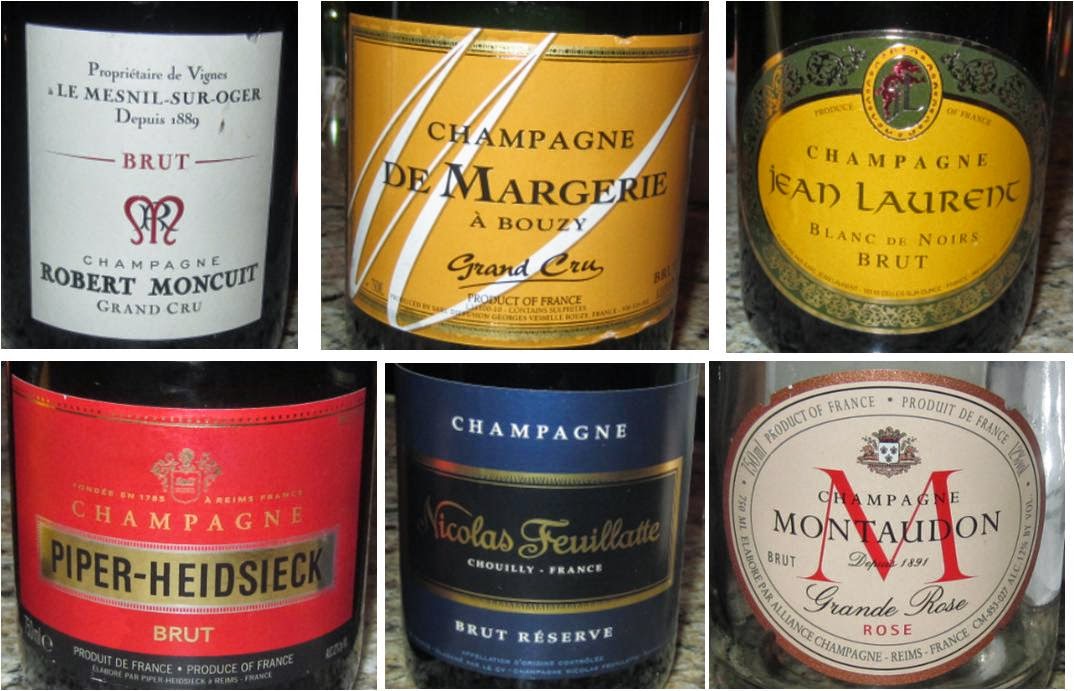
This past week, we attended the Frizzante Wine Bar and Speakeasy Champagne Class Part II. Every Wednesday, Steven, the owner teaches a class about wine. This was the second week that featured champagne. We went to the First Class where Jason Starkey stepped in to help Steven. Part II featured the following champagnes:
 Steven began the class by grabbing our attention saying that Steven Spielberg's Jurassic Park and Champagne have something in common...the end of the dinosaurs and the creation of the chalk layer in Champagne that is critical to making this bubbly wine. Steven explained about the 5 regions in Champagne that make the bubbly stuff, taught us about grand cru (great growth) vineyards, and about grower producers. One of the interesting champagnes that we tasted was the Nicolas Feuillatte Champagne. Initially, this champagne was the vision of Nicolas Feuillatte, however, in 1986, Feuillatte relinquished the brand to the Centre Vinicole de la Champagne (CVC), which would later become the iconic Centre Vinicole – Champagne Nicolas Feuillatte. This move by Feuillatte united 82 cooperatives in Champagne giving the brand access to 2,250 hectares of vineyards. We have had this champagne before and my husband knew that it was made by a commune. It is available locally and sells for approximately $35.00, a very good value. We enjoyed the evening, sitting in the company of 6 other people, as well as our friend Barry. Every Wednesday, The Frizzante Wine Bar and Speakeasy conducts a wine appreciation class, the next class is about the red wines of the Old World.

Thursday, May 15, 2014
We're Lineposting!


We were getting the hang of it and finished the first row when the whatyoumacallit that you put on top of the line post to allow the hydraulic pounder to pound in the line post snapped! It didn't break at the welding joint, the metal broke! I have to admit it was a nice break (for me), and when we went home, we ordered 5 more just to have spares around.
Monday, May 12, 2014
Spined Soldier Beetle: Hello to Good Predators

Look-Alike Insects
Last year, we were indiscriminately destroying things that we saw in the vineyard before we knew what it was and one that we deeply regretted was destroying the eggs of the spined soldier beetle. I feel that the eggs of the spined soldier beetle are one of Nature's little beauties. In looking back at my notes, this particular beetle that we saw is a spined soldier beetle Podisus maculiventris (Say), so welcome back, little guy! Be fruitful and multiply!
References:
1. University of Florida, Life Cycle of the Spined Soldier Beetle
2. Cornell University Biological Control Site
3. Stop BMSB
Saturday, May 10, 2014
Various Stages of Dormancy
We were asked by our vineyard consultant to spray lime sulfur on our dormant vines to control overwintering diseases that could be in our vineyard. He stressed that the buds should be in their closed state because application of lime sulfur to a bud that is in the budburst stage can burn the nascent leaves. We were seeing all different stages of dormant buds which prompted me to look at more photos of grape buds in their dormant stage. I found a really good research paper on the internet: Adoption of a system for identifying grapevine growth stages, authored by B. G. Coombe. In this research paper, I found detailed descriptions of the various stages of vine phenology based on the Eichhorn Lorenz system. I took photos of our Chenin blanc buds and put it against the silhouettes provided in the paper and came up with the following:
 At the moment, approximately 3% (or about 200 out of 6804 vines) of our buds are at stage 5 which is the "rosette of leaf tips visible" stage. Interestingly, most of these vines are located at the south end of the vineyard and it doesn't matter which variety it is i.e. Auxerrois, Chenin blanc or Chardonnay. It appears, however, that our Chenin blanc are the most advanced and our Auxerrois are the laggards.
References:
1. B. G. Coombe, Adoption of a system for identifying grapevine growth stages, Australian Journal of Grape and Wine Research 1, 100-110, 1995.

References:
1. B. G. Coombe, Adoption of a system for identifying grapevine growth stages, Australian Journal of Grape and Wine Research 1, 100-110, 1995.
Subscribe to:
Posts (Atom)