Pages
- Welcome
- Home
- Online Resources
- Starting a Vineyard
- Viticulture
- Enology
- Grape and Wine Chemistry
- Grapevine Diseases
- Insect Pests and Predators
- Vintage Notes
- Wine Tastings
- Wines Under $20
- Champagne
- Chenin Blanc
- Meetings and Workshops
- Book Reviews
- On the Wine Trail
- Esoterica
- Vineyard Sightings
- Winery Configuration
Thursday, May 8, 2014
Frizzante Wine Bar and Speakeasy
We went to Frizzante last evening for a class on champagne in our quest to continue our education about the bubbly. We were to meet our friends Mary and Barry there, but Barry, who is the real champagne aficionado was ill with something that Mary had the previous week. The class is usually taught by the owner, Steven, but tonight, Jason Starkey stepped in at the last moment to conduct the class. Usually, the class is free, but this evening there was a nominal fee of $15.00 to taste 6 champagnes. During the tasting, we ordered off of their tapas menu. All of the tapas are $5.00 so it made the tasting a wonderful repast. We began the tasting with a champagne called Veuve Fourny & Fils Grande Reserve Premier Cru Brut. It is made from 80% Chardonnay and 20% Pinot noir. The Veuve Fourny is imported by Kermit Lynch. We learned from Jason that part of the cuvée goes through malolactic fermentation. I did not know that. The next champagne that we were served was the Moët & Chandon Impérial Brut Champagne. I thought that the addition of Pinot Meunier in the Moët & Chandon Impérial, made this champagne taste a bit more complex and not as austere as the Veuve Fourny. We moved on to tasting the Heidsieck Monopole "Blue Top" Brut Champagne, similar in composition of grapes to the Moët & Chandon. The fourth champagne that we tasted was the Montaudon Brut Depuis 1891 followed by the Forget-Brimont Premier Cru Brut. We thought that the Forget-Brimont Premier Cru Brut had a nose of Camembert cheese. We ended the evening with a taste of Ayala and learned from Jason that is contains no dosage. During the course of the champagne tasting, Jason answered questions, talked about food pairings with champagne and explained the various bottle formats that champagne can come in. Jason did a great job of leading the class and we learned a lot by having the opportunity to taste and compare the various champagnes.
Tuesday, May 6, 2014
Cool Sighting: Six Spotted Tiger Beetle
One of the delights of working in the vineyard is seeing the various and interesting forms of life. This iridescent green beetle did not escape even my poor eyesight and it remained still enough for me to take several photos. This is called a six spotted tiger beetle (Cicindela sexguttata)) and is about half and inch long.
Six-spotted tiger beetles live in loamy and sandy soils in eastern hardwood forests and are occasionally found in open pine forests. Adults are primarily active in the spring from April to early July.
This beetle is one of the good guys because it eats small insects, spiders, and other arthropods. Favorite foods include other beetles, springtails, sawflies, caterpillars, flies, ants, and grasshoppers. To avoid predators this insect relies on its speed, agility, and ability to secrete a noxious chemical. This noxious chemical has been identified as benzaldehyde, a highly volitle aldehyde that diffuses readily into the surrounding air. It is a non-specific irritant.
Reference:
1. Hays, Cummins, Cicindela sexguttata.
2. Nature's Notebook, Cicindela sexguttata.
3. Jason P. Schmidt, Cicindelidae of Colorado.
Six-spotted tiger beetles live in loamy and sandy soils in eastern hardwood forests and are occasionally found in open pine forests. Adults are primarily active in the spring from April to early July.
This beetle is one of the good guys because it eats small insects, spiders, and other arthropods. Favorite foods include other beetles, springtails, sawflies, caterpillars, flies, ants, and grasshoppers. To avoid predators this insect relies on its speed, agility, and ability to secrete a noxious chemical. This noxious chemical has been identified as benzaldehyde, a highly volitle aldehyde that diffuses readily into the surrounding air. It is a non-specific irritant.
Reference:
1. Hays, Cummins, Cicindela sexguttata.
2. Nature's Notebook, Cicindela sexguttata.
3. Jason P. Schmidt, Cicindelidae of Colorado.
Sunday, May 4, 2014
Weeds and Chemical Defense in Our Vineyard
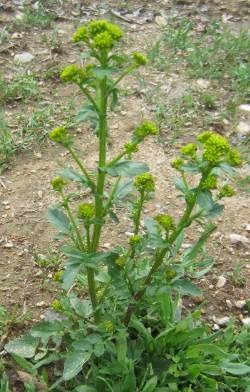
We began weeding our vineyard rows on Friday, the first nice day after the rains. We found a plethora of these weeds with yellow flowers on the north side of the vineyard and began hoeing them out. A search on the Internet revealed that these weeds are from the mustard family and are called Barbarea vulgaria or yellow rocket. Knowing the weeds in the vineyard can be a clue to the type of soils. In the book Weeds of the Northeast, written by Richard H. Uva, Joseph C. Neal and Joseph M. DiTomaso, they mention that the yellow rocket is most common on nutrient rich sandy and loamy soils. Precisely the type of soil that we have. On very close inspection of the yellow rocket, we found some very tiny beetles and were able to identify the beetles as well. The beetles are Phyllotreta nemorum, a flea beetle that likes to feed on the yellow rocket making little shot holes in the leaves.
There is an interesting interatcion between the yellow rocket and the flea beetle reported in the research paper Identification of Defense Compounds in Barbarea vulgaris against the Herbivore Phyllotreta nemorum by an Ecometabolomic Approach written by Vera Kuzina, Claus Thorn Ekstrøm, Sven Bode Andersen, Jens Kvist Nielsen, Carl Erik Olsen and Søren Bak and available on line:1
The Barbarea vulgaria the yellow rocket, a member of the mustard family, has developed chemical defense against the Phyllotreta nemorum flea beetle in the form of saponins, which are triterpenoid glycosides. These saponins are constituents of many plant drugs and folk medicines and possess a wide range of biological activities, including antifungal, antibacterial, molluscicidal, and insecticidal activities. The toxicity of saponins to fungi and insects is thought to be a result of their ability to form complexes with sterols in the plasma membrane, thus destroying the cellular semipermeability and leading to cell death. Although saponins are toxic to cold-blooded animals, their oral toxicity to mammals is low. I found the chemical structures of these saponins in another online article:2
The yellow rocket exists as two genotypes, the P and the G. The pubescent P-type is susceptible to all known flea beetle genotypes, whereas the glabrous G-type is resistant to most common genotypes of the insect. We must have the susceptible P-type genotype growing in our vineyard!
References:
1. Vera Kuzina, Claus Thorn Ekstrøm, Sven Bode Andersen, Jens Kvist Nielsen, Carl Erik Olsen and Søren Bak, Identification of Defense Compounds in Barbarea vulgaris against the Herbivore Phyllotreta nemorum by an Ecometabolomic Approach, Plant Physiology, December 2009, vol. 151 no. 4 1977-1990.
2. Jörg M. Augustin, Sylvia Drok, Tetsuro Shinoda, Kazutsuka Sanmiya, Jens Kvist Nielsen, Bekzod Khakimov, Carl Erik Olsen, Esben Halkjær Hansen, Vera Kuzina, Claus Thorn Ekstrøm, Thure Hauser and Søren Bak, UDP-Glycosyltransferases from the UGT73C Subfamily in Barbarea vulgaris Catalyze Sapogenin 3-O-Glucosylation in Saponin-Mediated Insect Resistance, Plant Physiology December 2012, vol. 160 no. 4 1881-1895.
The Barbarea vulgaria the yellow rocket, a member of the mustard family, has developed chemical defense against the Phyllotreta nemorum flea beetle in the form of saponins, which are triterpenoid glycosides. These saponins are constituents of many plant drugs and folk medicines and possess a wide range of biological activities, including antifungal, antibacterial, molluscicidal, and insecticidal activities. The toxicity of saponins to fungi and insects is thought to be a result of their ability to form complexes with sterols in the plasma membrane, thus destroying the cellular semipermeability and leading to cell death. Although saponins are toxic to cold-blooded animals, their oral toxicity to mammals is low. I found the chemical structures of these saponins in another online article:2
The yellow rocket exists as two genotypes, the P and the G. The pubescent P-type is susceptible to all known flea beetle genotypes, whereas the glabrous G-type is resistant to most common genotypes of the insect. We must have the susceptible P-type genotype growing in our vineyard!
References:
1. Vera Kuzina, Claus Thorn Ekstrøm, Sven Bode Andersen, Jens Kvist Nielsen, Carl Erik Olsen and Søren Bak, Identification of Defense Compounds in Barbarea vulgaris against the Herbivore Phyllotreta nemorum by an Ecometabolomic Approach, Plant Physiology, December 2009, vol. 151 no. 4 1977-1990.
2. Jörg M. Augustin, Sylvia Drok, Tetsuro Shinoda, Kazutsuka Sanmiya, Jens Kvist Nielsen, Bekzod Khakimov, Carl Erik Olsen, Esben Halkjær Hansen, Vera Kuzina, Claus Thorn Ekstrøm, Thure Hauser and Søren Bak, UDP-Glycosyltransferases from the UGT73C Subfamily in Barbarea vulgaris Catalyze Sapogenin 3-O-Glucosylation in Saponin-Mediated Insect Resistance, Plant Physiology December 2012, vol. 160 no. 4 1881-1895.
Friday, May 2, 2014
2010 Wolffer Perle Chardonnay
It has been raining for most of Wednesday and Thursday and the tally for our corner of Connecticut is close to 3.0 for those days. It's still drizzling today. The rain put a halt to any work we were planning to do out in the vineyard.
A few nights ago, we had our friends over for dinner so even though it was pouring down rain outside, inside, we were having a great time. For this night, we began with smoked salmon and crackers and oysters which we paired with Nicolas Feuillatte champagne. We moved on to this 2010 Wolffer Perle Chardonnay which we procured when we visited Wölffer Estate this past August. We paired the Chardonnay with Sweet Pea Risotto, a recipe from the Real Simple site. We topped the risotto with seared Stonington scallops and it was a delicious pairing. In addition to the Wolffer Chardonnay, we also drank a 2012 Vignoble Dampt Les Fourneaux Premier Cru, which had a bit more acidity than the Wolffer. It was a very pleasant midweek evening in the company of good friends.
Subscribe to:
Posts (Atom)