We've been administering our soft chemical comprised of hydrogen dioxide and acetic acid to our vines and they are responding! Grapevines are amazingly resilient. We have also benefited from the rain events in September that helped the vines to push new leaves. Although we are thankful for the rain, we are cognizant that rain is not so good for established vineyards in our area whose grapes may already be near harvest. Rain events close to harvest may swell the grapes causing them to burst and attract wasps, bees, fruitflies and other insects that carry grape berry diseases that may cause the berries to rot.
In our case, the rains have helped our young vines to grow new leaves. Our hope is that they will have enough time to photosynthesize and create the carbohydrates necessary for the grapevine survival during the upcoming winter.
Pages
- Welcome
- Home
- Online Resources
- Starting a Vineyard
- Viticulture
- Enology
- Grape and Wine Chemistry
- Grapevine Diseases
- Insect Pests and Predators
- Vintage Notes
- Wine Tastings
- Wines Under $20
- Champagne
- Chenin Blanc
- Meetings and Workshops
- Book Reviews
- On the Wine Trail
- Esoterica
- Vineyard Sightings
- Winery Configuration
Monday, September 9, 2013
Friday, September 6, 2013
Erysiphe necator: Powdery Mildew
Sadly, we are learning at the school of hard knocks that we cannot keep our vineyard chemical free and in fact if we want to maintain a healthy vineyard we must judiciously choose and use some chemicals appropriately. To recap this growing season for us, the spring was cool with almost no rain, which is a little unusual for the Northeast. Our vineyard was planted in the third week in May and a deluge of rain followed in the month of June. To top this off, July was the hottest on record in the state of Connecticut. July was so hot and humid that our vines grew aerial roots. We heard from some of our Long Island friends that they needed to irrigate in July. So far we have had only two rain events in the month of August, on the 9th and on the 27th, which is to say, we haven't had much rain.
I mention the weather because, although we heard from other vineyardists that typically, the inoculum for powdery and downy mildew are not present in a newly planted vineyard, we found our plants infested with downy. We were well aware of our problem with downy mildew but we were unprepared to hear the next bit of news. We sent Fritz Westover the photo shown on the left and he identified for us that this photo shows a shoot infected with
powdery mildew (PM). Powdery mildew or Erysiphe necator is also known as Uncinula necator and is commonly called oidium.
I found an excellent article written by Michelle Moyer, Extension Specialist and Gary Grove, Plant Pathologist at Washington State University titled Grapevine Powdery Mildew illustrated with some photos that showed that our shoot (and much of our vineyard) does in fact have symptoms of PM as explained in the article.
Upper: Shoots infected by powdery mildew exhibit classic, grey web-like scarring.
Middle: Fall periderm formation and
Lower: Spring infections are noticeable as brown to red web-like discolorations on the cane.
Photos by Michelle Moyer.1
Powdery mildew prefers mild temperatures between 68 and 85°F, relative humidity levels above 75%, and low levels of solar radiation. We had those conditions in spades in July. In the article from Washington State University, Moyer and Grove mention that the disease should be properly managed in the current year because that will influence how powdery mildew develops in the following year. If incompletely managed in Year 1, the fungus will mate and form overwintering structures called chasmothecia on infected fruit and foliage.
We are now faced with trying to beat down the inoculum before the onset of winter.
Reference:
1. Michelle Moyer, Viticulture Extension Specialist and Gary Grove, Plant Pathologist, WSU-IAREC, Grapevine Powdery Mildew.
I found an excellent article written by Michelle Moyer, Extension Specialist and Gary Grove, Plant Pathologist at Washington State University titled Grapevine Powdery Mildew illustrated with some photos that showed that our shoot (and much of our vineyard) does in fact have symptoms of PM as explained in the article.
Upper: Shoots infected by powdery mildew exhibit classic, grey web-like scarring.
Middle: Fall periderm formation and
Lower: Spring infections are noticeable as brown to red web-like discolorations on the cane.
Photos by Michelle Moyer.1
Powdery mildew prefers mild temperatures between 68 and 85°F, relative humidity levels above 75%, and low levels of solar radiation. We had those conditions in spades in July. In the article from Washington State University, Moyer and Grove mention that the disease should be properly managed in the current year because that will influence how powdery mildew develops in the following year. If incompletely managed in Year 1, the fungus will mate and form overwintering structures called chasmothecia on infected fruit and foliage.
We are now faced with trying to beat down the inoculum before the onset of winter.
Reference:
1. Michelle Moyer, Viticulture Extension Specialist and Gary Grove, Plant Pathologist, WSU-IAREC, Grapevine Powdery Mildew.
Wednesday, September 4, 2013
2011 Abbazia di Novacella Kerner
My husband gave me a little tasting test one early evening after working on the land. He brought out two glasses of a white wine, one for him and one for me and asked me to guess what it was. I was surprised by it's fragrant, floral nose and honeydew flavor with crisp acidity. What was this? Virginia Viognier was my guess. My second guess was "Riesling", close but no cigar was the answer. In the end, I would never have guessed it because Kerner was a grape variety that I have never had before. In Jancis Robinson's book, Wine Grapes, the entry for Kerner mentions that it is a cross between Riesling and Schiava grossa, bred by August Herold at the Weinsberg research centre.1 The Schiava grossa is also known as Vernatsch, Trollinger or Black Hamburg, yes, a red grape variety!
Kerner is grown in the northern most wine region in Italy called the Alto Adige also known as the Südtirol due to its bicultural Italian-Austrian heritage.2 The Kerner buds late, giving it good frost resistance and ripens mid to late, making this grape a good candidate for cooler climates. Jancis Robinson also wrote that Kerner is grown in Hokkaido, the northernmost island in Japan. Now, that is cold tolerance!
Update: My husband found an online article from the San Francisco Chronicle on Alto Adige's white wines charm - in 2 languages. This article mentions that Abbazia di Novacella is a historic abbey in the Isarco Valley. The Kerner label is in two languages, Italian and German, so Abbazia di Novacella could also be called Kloster Neustift. That clarified for me, what Stiftskellerei Neustift stood for.
References:
1. J. Robinson, J. Harding and J. Vouillamoz, Wine Grapes - A complete guide to 1,368 vine varieties, including their origins and flavours, pg 502-503, Allen Lane 2012 ISBN 978-1-846-14446-2.
2. Südtirol Wein Vini Alto Adige.
Additional Information:
Wikipedia Entry for Kerner Grape.
Kerner is grown in the northern most wine region in Italy called the Alto Adige also known as the Südtirol due to its bicultural Italian-Austrian heritage.2 The Kerner buds late, giving it good frost resistance and ripens mid to late, making this grape a good candidate for cooler climates. Jancis Robinson also wrote that Kerner is grown in Hokkaido, the northernmost island in Japan. Now, that is cold tolerance!
Update: My husband found an online article from the San Francisco Chronicle on Alto Adige's white wines charm - in 2 languages. This article mentions that Abbazia di Novacella is a historic abbey in the Isarco Valley. The Kerner label is in two languages, Italian and German, so Abbazia di Novacella could also be called Kloster Neustift. That clarified for me, what Stiftskellerei Neustift stood for.
References:
1. J. Robinson, J. Harding and J. Vouillamoz, Wine Grapes - A complete guide to 1,368 vine varieties, including their origins and flavours, pg 502-503, Allen Lane 2012 ISBN 978-1-846-14446-2.
2. Südtirol Wein Vini Alto Adige.
Additional Information:
Wikipedia Entry for Kerner Grape.
Monday, September 2, 2013
Eight Spotted Forester
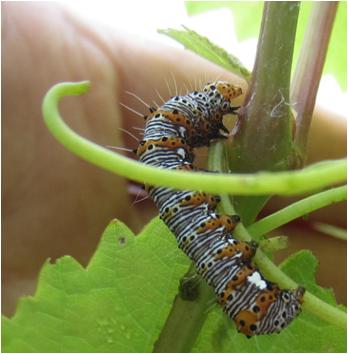
In June, we found this beautiful caterpillar and identified it at that time. I was recently going through all the vineyard images that we took, reliving our first season. I came upon this photo and couldn't remember what it was. Finally, after about 20 minutes of searching on the Internet, I was able to locate a site that identified the caterpillar. I thought I would blog about it, belatedly, so that I don't forget, again!
This is the caterpillar of the Eight Spotted Forester, Alypia octomaculata. They range from Maine and southern Quebec to Florida and west to South Dakota and Texas. The caterpillar feeds on grapevines and Virginia creeper.1 Ah, that explains it. It belongs to the Family Noctuidae, or the owlet moth. A relative of the Eight spotted forester that also attacks grapevines is called the Psychomorpha epimenis or the grapevine epimensis.
I found an image of the Eight Spotted Forester moth at A Prairie Haven.2 The eight Spotted Forester moth looks like this:
A very appropriate descriptive name, wouldn't you say.
References:
1. Butterflies and Moths of North America.
2. A Prairie Haven
This is the caterpillar of the Eight Spotted Forester, Alypia octomaculata. They range from Maine and southern Quebec to Florida and west to South Dakota and Texas. The caterpillar feeds on grapevines and Virginia creeper.1 Ah, that explains it. It belongs to the Family Noctuidae, or the owlet moth. A relative of the Eight spotted forester that also attacks grapevines is called the Psychomorpha epimenis or the grapevine epimensis.
I found an image of the Eight Spotted Forester moth at A Prairie Haven.2 The eight Spotted Forester moth looks like this:
A very appropriate descriptive name, wouldn't you say.
References:
1. Butterflies and Moths of North America.
2. A Prairie Haven
Subscribe to:
Posts (Atom)