Pages
- Welcome
- Home
- Online Resources
- Starting a Vineyard
- Viticulture
- Enology
- Grape and Wine Chemistry
- Grapevine Diseases
- Insect Pests and Predators
- Vintage Notes
- Wine Tastings
- Wines Under $20
- Champagne
- Chenin Blanc
- Meetings and Workshops
- Book Reviews
- On the Wine Trail
- Esoterica
- Vineyard Sightings
- Winery Configuration
Friday, June 28, 2019
1987 La Tâche and 1995 Romanée Saint-Vivant
My husband has mastered the art of slow smoking duck breast. His method adds a smokiness to the fat cap and keeps the duck nice and tender and juicy. He also has a berry sauce that is the perfect match for the smoked duck breast. We had the duck with a side of wild rice with mushrooms.
We had two wines to pair with the duck dinner. One was a 1987 La Tâche and the other was a 1995 Romanée Saint-Vivant.
My husband decanted the La Tâche right as we were serving the duck. The color of the La Tâche was sparkling ruby in the glass. The edges of the La Tache in the wine glasses didn't show much oxidation for it's age. We tasted a blend of red cherries, a bit of spiciness and it was very well integrated with smooth tannins. The 1995 Romanée Saint-Vivant was more darkly extracted, looking more like dark garnet in the glass. It tasted very youthful and had a little tannin bite at the end. However, both wines were a delicious compliment to the smoked duck.
Sadly, that was the last of the La Tâche, but this may have been the right time to drink it. My husband claims that he has three more bottles of the 1995 Romanée Saint-Vivant, which I think can be cellared for many more years.
Tuesday, June 25, 2019
Chardonnay in Bloom
Our Chardonnay have begun to bloom. They may have started to bloom on Friday, when we had rain throughout the day. We noticed the blooms on Saturday when we were back in the vineyard working on the north end of the vineyard. It seemed that there were more Chardonnay in bloom on the north end compared to the south end. We think that the north end of the vineyard has more sun than the south end.
There is another rain event coming tomorrow, Tuesday, June 25. We hope that enough of the Chardonnay flowers have bloomed so that the rains will not have too much of an effect.
Sunday, June 23, 2019
Rain, Thank U, Next: Sunshine Please
We have had so many rainy days this spring and summer. Yesterday when we were in the vineyard doing chores, a veritable deluge came down which lasted only a few minutes, but enough to scare us off. So, what do we do when it is raining. Indoor chores, including testing our red wines.
In 2018, we had our first very small harvest of our red grapes which I blogged about in Vintage 2018: Cabernet Sauvignon and Cabernet Franc Harvest. We inoculated the Cabernet Sauvignon with VIN13 which we made into a rosé. For the Cabernet Franc, we decided to try our hand at making a red wine and used the yeast F15. F15 is a yeast that can yield fruity, round, and aromatic wines. The yeast also produces glycerol which can lead to wines with a good mouthfeel.
In addition to taking the parameters for our red wines, we also tasted it. The color was really nice. Without any fining or filtering, they were both very clear. Here is a view of our wines from the top: Our tasting notes: The Cabernet Sauvignon rosé tasted like sour cherries, it was very dry and had a bit of tannin flavor. Our Cabernet Franc tasted a bit "stemmy".
Next up for our red is bottling time!
In 2018, we had our first very small harvest of our red grapes which I blogged about in Vintage 2018: Cabernet Sauvignon and Cabernet Franc Harvest. We inoculated the Cabernet Sauvignon with VIN13 which we made into a rosé. For the Cabernet Franc, we decided to try our hand at making a red wine and used the yeast F15. F15 is a yeast that can yield fruity, round, and aromatic wines. The yeast also produces glycerol which can lead to wines with a good mouthfeel.
In addition to taking the parameters for our red wines, we also tasted it. The color was really nice. Without any fining or filtering, they were both very clear. Here is a view of our wines from the top: Our tasting notes: The Cabernet Sauvignon rosé tasted like sour cherries, it was very dry and had a bit of tannin flavor. Our Cabernet Franc tasted a bit "stemmy".
Next up for our red is bottling time!
Thursday, June 20, 2019
A Tale of Two Net Positions
When we put up our netting in 2017, the question we asked ourselves was should the netting be "stored" up high or should the netting be kept low? Since my husband uses a mechanical weeder when the weeds grow, putting the netting low didn't seem to be such a good option. So, in 2017, after harvest, we rolled up the netting and kept it on the catchwire like so:
When growing season came last year, the netting that we rolled very tightly in the fall, looked like this after the winter and the winds.
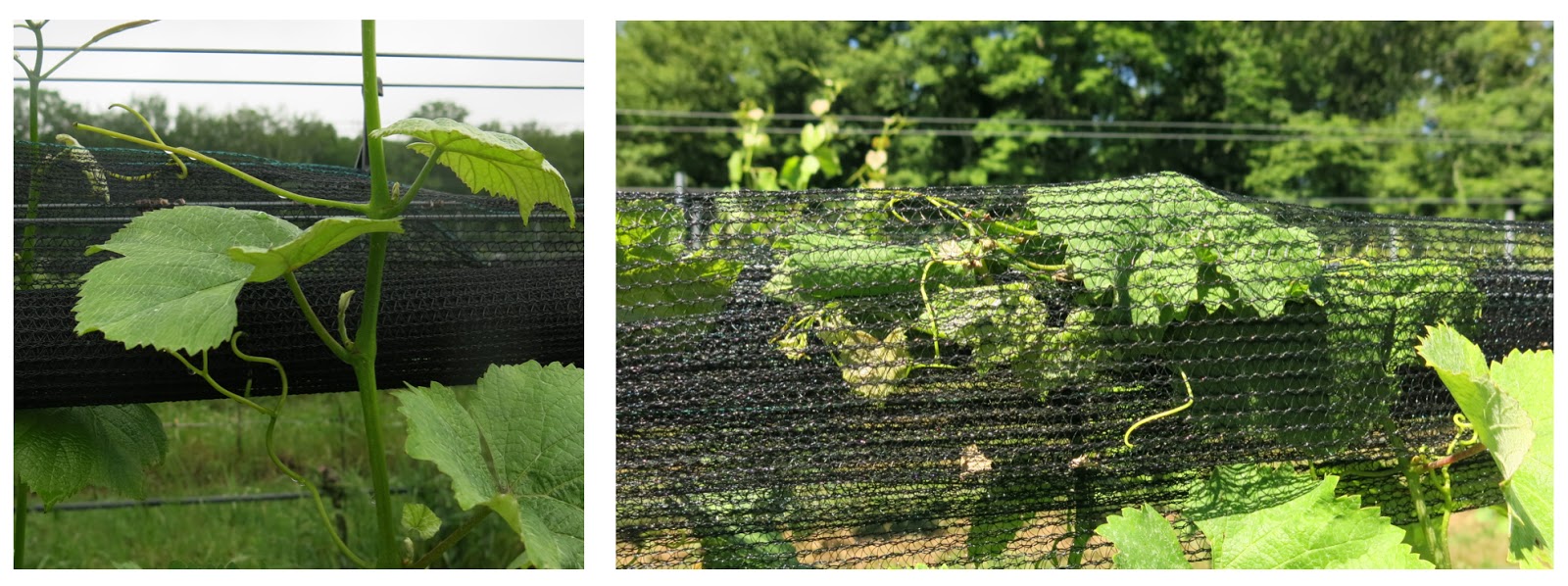
The loose netting created multiple problems including the vine growing outside of the netting, tendrils growing into the loose netting and the growing tips of the vines getting trapped in the netting.
A lot of care had to be taken to untangle the tendrils from the netting, move the tendrils into the catch wires and remove the growing tips of the vines from the netting.
This year, we knew that we had three problems that we had to address:
1: How to move the netting so that we could avoid tendril issues
2: Where to move the netting so that we could avoid tendril issues
3: How to more securely cinch the netting so that it doesn't unfurl
To address the first issue, we switched over the netting from the catchwires to a moveable wire. We also decided to lift the netting to a higher trellis post setting during the initial growing season. For the third issue, we put more ties on the netting to secure it better. Here is our Chenin Blanc with the netting on the higher setting: This is the result of moving the trellis wire in the Chardonnay which is way ahead of our Chenin Blanc in growth. It is much easier to shoot position the Chardonnay. If the vines have grown outside of the catch wires, it is not a problem to move them into the catch wires. Once all of the vines are at the top of trellis, we will move the rolled netting onto the lower setting in preparation for netting the grapes sometime in August.
We hope that this will alleviate the removal of the tendrils from the netting. We will see.
This year, we knew that we had three problems that we had to address:
1: How to move the netting so that we could avoid tendril issues
2: Where to move the netting so that we could avoid tendril issues
3: How to more securely cinch the netting so that it doesn't unfurl
To address the first issue, we switched over the netting from the catchwires to a moveable wire. We also decided to lift the netting to a higher trellis post setting during the initial growing season. For the third issue, we put more ties on the netting to secure it better. Here is our Chenin Blanc with the netting on the higher setting: This is the result of moving the trellis wire in the Chardonnay which is way ahead of our Chenin Blanc in growth. It is much easier to shoot position the Chardonnay. If the vines have grown outside of the catch wires, it is not a problem to move them into the catch wires. Once all of the vines are at the top of trellis, we will move the rolled netting onto the lower setting in preparation for netting the grapes sometime in August.
We hope that this will alleviate the removal of the tendrils from the netting. We will see.
Subscribe to:
Posts (Atom)